

The Best Pool Test Kit for DIY Pool Owners

After 30 years of using every pool testing product on the market, I found that the most reliable pool test kit is the Taylor K-2006 liquid test kit. It tests for free and total chlorine, pH, total alkalinity, calcium hardness, and cyanuric acid. What you want is either a DPD or FAS-DPD kit, and Taylor makes the best of both.
Regular pool chemistry testing is a crucial part of pool maintenance. But there are very different testing methods that provide different and sometimes more accurate results.
- Liquid test kits offer a broader range of pool water testing. They’re accurate but have a fairly steep learning curve. They require precision when adding liquid reagents. Otherwise, you could get inaccurate results. All that said, this is the best kind of pool test kit you can buy. They’re affordable, refillable, and reliable.
- Test strips are the most cost-effective and easiest way to test your pool water. But they’re limited in what they measure, and they can be contaminated easily if they’re left unsealed or exposed to moisture. I recommend using them for quick, high-level testing when accuracy is not a huge concern.
- Digital kits (advanced) are fast, accurate, and great for anyone who has trouble reading color. However, they’re more expensive than other types of pool test kits. I think, at their current state, they’re a little overkill for regular pool owners. But I’m hoping they become more affordable over time.
Taylor Test Kit K-2005 vs. K-2006
For most pool owners, the Taylor K-2005 is fine. It’s accurate, reliable, and straightforward. But if your chlorine is above 10 ppm (like right after shocking), the sample can bleach out and give you a false clear reading. It also requires color matching, which can be hard for some people.
For just $20-$30 more, upgrade to the Taylor K-2006C. It’s more accurate and eliminates color matching. Just count the drops you’re adding until the water sample turns from pink to clear. It also lets you measure chlorine up to 50 ppm. This is what most professionals use.

This test kit lets you check all your pool's important chemical levels at home in minutes, so you always know exactly what to add and never waste money overtreating your water.
Best Test Kit For Saltwater Pools and Salt Levels
If you have a saltwater pool, you can get the Taylor K-2006-SALT kit. But you really don’t need it. Most saltwater generators (SWG) do salt testing. Or you can buy a separate digital salinity meter. But since you only have to check your salt level maybe once or twice a year, it’s not worth the upgrade.
Here’s How to Use a Liquid Test Kit
First, you need to collect your water sample. I recommend using this water sample bottle for this, so you can keep reusing it for each test.
Take a sample after your pump has been running for an hour and away from a skimmer or return jet. Insert the bottle upside down and elbow deep. Then, turn the bottle right-side up to collect the sample.
Add the kit’s reagents to the water sample. Make sure you fully invert the bottle when you squeeze out the drops. Meaning the bottle should be straight up and down. This will give you the most accurate readings.
For the K-2005 kit, compare the color change to the chart. For the K-2006’s chlorine test, count drops until the color disappears. Replace your reagents at the start of every season. They have a one-year shelf life.
NOTE: Refill kits for these will run you about $60 after tax. And I recommend refilling your test kit every year. The liquid reagents have a short shelf life.
What About Using Affordable Pool Test Strips?
I like using test strips if you’re having a party or just want to make sure your chemistry levels are roughly in range. They’re not super accurate, but they’re easy to use, and that’s why I like them. I would rather you test your pool than not test at all.
When you’re buying test strips, go with a well-known brand like Taylor, AquaChek, or LaMotte. Avoid knock-off brands on Amazon. They’re not reliable, and the minor savings aren’t worth it.
The AquaChek 7-Way Test Strips are my favorite and measure everything you need: total hardness (which helps you measure calcium hardness), total chlorine, total bromine, free chlorine, pH, total alkalinity, and cyanuric acid. LaMotte Insta-Test strips are great, too. Look for the 6-way or 7-way options.
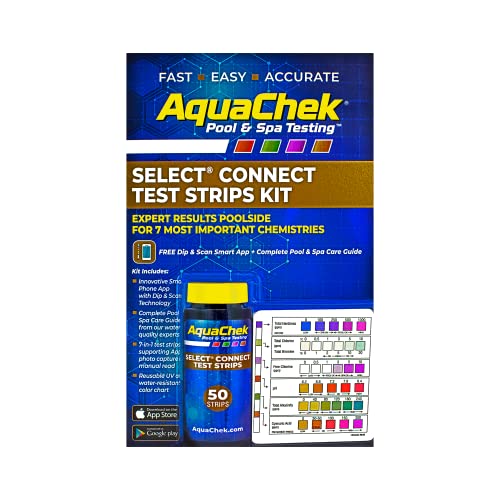
Tests for 7 important chemistries in seconds: Total Hardness, Total Chlorine, Total Bromine, Free Chlorine, pH, Total Alkalinity, and Cyanuric Acid.
How to Use Test Strips
Dip the strip into a water sample collected from the middle of your pool, elbow deep. Remove it quickly, hold it still for 15 seconds, and compare the colors to the chart on the bottle.
Don’t shake the strip, don’t touch the pads, and do this in natural daylight for the clearest read.
NOTE: Store your test strips in a cool, dry place. Ideally, indoors and away from humidity if you can. Make sure the lid is secure. And try not to touch the pads with your fingers when pulling out each strip to test. Test strips typically last 1 year after opening the packaging and 2 years if unopened, so refresh your supply every pool season.
What About Digital Testers?
For most pool owners, a mid-range reader is plenty. But by mid-range, I mean like $200-$300. Digital readers aren’t cheap.
I like LaMotte as a company. And the LaMotte ColorQ digital photometer is great. It totally eliminates the guesswork around color matching. It tests free chlorine, total chlorine, bromine, pH, alkalinity, calcium hardness, and CYA.

This digital pool and hot tub water test kit checks for Free Chlorine, Total Chlorine, Bromine, PH, Alkalinity, Calcium Hardness, and Cyanuric Acid.
It works like a test kit. You collect a water sample in the test tube, add the reagents or tablets for each test, mix, and press a button to get a digital reading.
Just keep the vials clean and fill them to the exact line every time. You also need to “reset” the meter each time before adding your reagents.
The gold standard digital reader is the LaMotte Waterlink Spin Touch. It’s a professional-grade option that’s over $1,000. And it’s totally overkill for most homeowners.
What Pool Testing Products I Would Avoid
I would skip the cheap OTO kits. They only test total chlorine and pH, and can’t separate free chlorine from combined chlorine.
The other popular product I would suggest skipping is a digital water chemistry monitor. These use fragile probes to constantly measure limited things like pH and ORP. ORP stands for Oxidation-Reduction Potential and measures how effective your chlorine is.
I’ve been in this industry a long time. And I’ve seen products like these come and go. The first one I ever tried was made by GAME. It was terrible, and they stopped making it. Then I tried pHin, which showed promise. But the company was bought by Hayward, and they discontinued it.
I worked a bit with yet ANOTHER dead company called Sutro.
All of these products were expensive, didn’t test for everything you need, constantly monitored your water (which constantly pinged your phone), and some required a monthly subscription. Hard pass!
There are a few new ones out there, like Water Guru. Admittedly, I haven’t tested this product. But I understand the technology. And I just don’t recommend these products. So you can avoid them. Your bank account will thank you.
Key Takeaways
- The Taylor K-2006C liquid test kit is my top pick because it tests everything you need (free and total chlorine, pH, total alkalinity, calcium hardness, and cyanuric acid) and skips the color matching by having you count drops until pink turns clear.
- Choose your test type based on how much accuracy you want. Liquid kits are the most reliable, test strips are the cheapest and fastest for quick checks, and digital readers are accurate but pricey at $200 to $300 and up.
- The Taylor K-2005 works fine for most people, but the K-2006C is worth the extra $20 to $30 since it reads chlorine up to 50 ppm and won’t bleach out after you shock your pool.
- Reagents and strips don’t last forever. Replace liquid reagents every year (a refill runs about $60) and swap out test strips each season, since they last about 1 year opened and 2 years unopened.
- Stick with trusted test strip brands like AquaChek or LaMotte (Insta-Test), and skip the cheap Amazon knock-offs because the tiny savings aren’t worth the bad readings.
- Skip the basic OTO kits and the fragile digital water monitors. OTO kits can’t separate free from combined chlorine, and I’ve watched monitor companies like GAME, pHin, and Sutro come and go for years.