


The True Cost of Running a Hot Tub During The Winter in 2026
 Matt Giovanisci
  December 19, 2025
 Heating your hot tub in winter costs more money than it does in the summer. Most people pay between $30 and $60 per month to heat a hot tub in cold weather, but your actual costs depend on a few key factors:
- Your hot tub’s insulation and pump type
- The outside temperature
- The amount of time you use your hot tub
- Your local electricity rates
- The cleanliness of your filter and water
Here’s everything that affects your hot tub electricity bill in the winter and how to cut your costs.

Learn how to keep your hot tub clear while saving money so you can enjoy more soaking time without big costs. The Hot Tub Handbook covers every type of hot tub on earth.
How Expensive is it to Run a Hot Tub in Winter?
To calculate the cost of running your hot tub in cold weather, you need to know a few key numbers: your hot tub’s wattage in kilowatts (kW) and your electricity rate per kilowatt-hour (kWh).
Step 1: Find Your Hot Tub’s Wattage
Your hot tub manual or the manufacturer’s website should list the wattage, usually listed in kilowatts (kW). A typical heater uses 3-6 kW, and the circulation pump around 1.5 kW. If the number is listed in watts instead of kilowatts, just divide by 1,000. For example, 6,000 watts equals 6 kW.
Step 2: Find Your Electricity Rate
Your electricity bill or your utility company’s website should list your electricity rate per kilowatt-hour. The average electricity rate in the U.S. is approximately 16-17 cents per kilowatt-hour (kWh), according to the U.S. Energy Information Administration (EIA). Some utility companies adjust their rates based on the season or time of day, so your costs may be higher during peak evening hours or high-demand seasons.
Step 3: Estimate Your Hot Tub’s Daily Energy Consumption
Figure out how often your circulation pump, heater, and jets run each day. This includes circulating and heating the spa when it’s not in use, as well as running your jets while you’re in the spa. Keep in mind that your heater will run more frequently in cold weather to maintain its temperature.
Here’s an example cost calculation for using a hot tub twice a week with the jets on for 45 minutes:
- Circulation Pump for Filtering (0.25 kW): Runs 4 hours daily at 0.25 kW = 1 kWh per day.
- Heater (3 kW): Runs 2 hours daily at 3 kW = 6 kWh per day.
- Circulation Pump for Heating (0.25 kW): Runs 2 hours daily at 0.25 kW = 0.5 kWh per day.
- Jets (2 kW): Run 45 minutes at 2 kW twice a week. 45 x 2 x 2 = 180. 180/60 = 3 kW per week, or 0.43 kWh per day.
Total Energy Consumption = 1 kWh + 6 kWh + 0.5 kWh + 0.43 kWh = 7.93 kWh per day.
Step 4: Calculate Your Monthly Electricity Cost
Multiply by your electricity rate to calculate your daily and monthly costs:
Daily cost: 7.93 kWh per day x $0.16 per kWh = $1.27
Monthly cost: $1.27 x 30 = $38.10
What Impacts the Costs of Heating a Hot Tub in Winter
Lower temperatures, higher usage, and poor insulation can all contribute to higher costs for running your hot tub during the winter. Here’s what impacts your hot tub’s electric bill in cold weather:
1. Frequency of Use
The more often you use your spa, the more your jets, heater, and pump will run. If you use your hot tub several times a week, keep the temperature at 80°F (27°C) when it’s not in use. You’ll save energy while still being able to heat it quickly before soaking. For daily hot tub use, lower the temperature by at least 2°F (1°C), which can save up to 10 percent in energy costs.
2. Colder Temperatures
The colder it gets outside, the more it costs to heat. A 20-degree drop in temperature will cost you roughly $10 to $20 more each month. The bigger the temperature gap between your water and the air, the faster you lose heat and the more your heater will have to work.
3. Insulation
A waterlogged or ill-fitting cover allows heat to escape. Old hot tubs with poor insulation also cost more to run. Hot tubs exposed to wind and snow lose heat faster.
4. Filtration and Water Chemistry
A dirty filter or poor water chemistry can make your heater work harder. Clean filters help your system run efficiently, and balanced water chemistry helps prevent buildup inside your plumbing and equipment.
5. Pump Type
A well-insulated spa with a small circulation pump costs much less to run than a dual-speed pump. Expect to pay almost twice as much without a high-efficiency circulation pump.
6. Electricity Rates
Your electricity rate makes a huge difference in your total costs. While it’s out of your control if you live somewhere with high rates, check to see if there are different rates based on the time of day you use electricity.
Should You Leave Your Hot Tub On or Turn It Off?
Keeping your hot tub at a steady temperature is more cost-effective than repeatedly heating cold water, so leave it on.
Once water reaches your target temperature, maintaining it takes minimal electricity compared to reheating cold water. This also wears out your heater faster. You also need to maintain some heat in the spa to prevent freezing.
If you use your spa more than once a week, maintain a steady temperature of 80°F (27°C).
The Most Economical Way to Run a Hot Tub in Winter
You can’t control the weather or your electricity rates, but you can control how you use your hot tub. Here’s how to lower your costs:
Temperature Management
- Keep your hot tub at 80°F (27°C) if you use it more than once a week
- Drop the temperature lower between uses if you soak less often
- Use freeze protection mode when you’re not using it regularly. Check out our guide on how to keep your hot tub from freezing.
- For daily hot tub users, lower your temperature by one or two degrees to cut electric use by 10 percent
Cover and Insulation
- Use a quality cover that fits properly
- Replace damaged covers immediately
- Keep covers clean to extend their lifespan
- Make sure the corner flaps seal completely
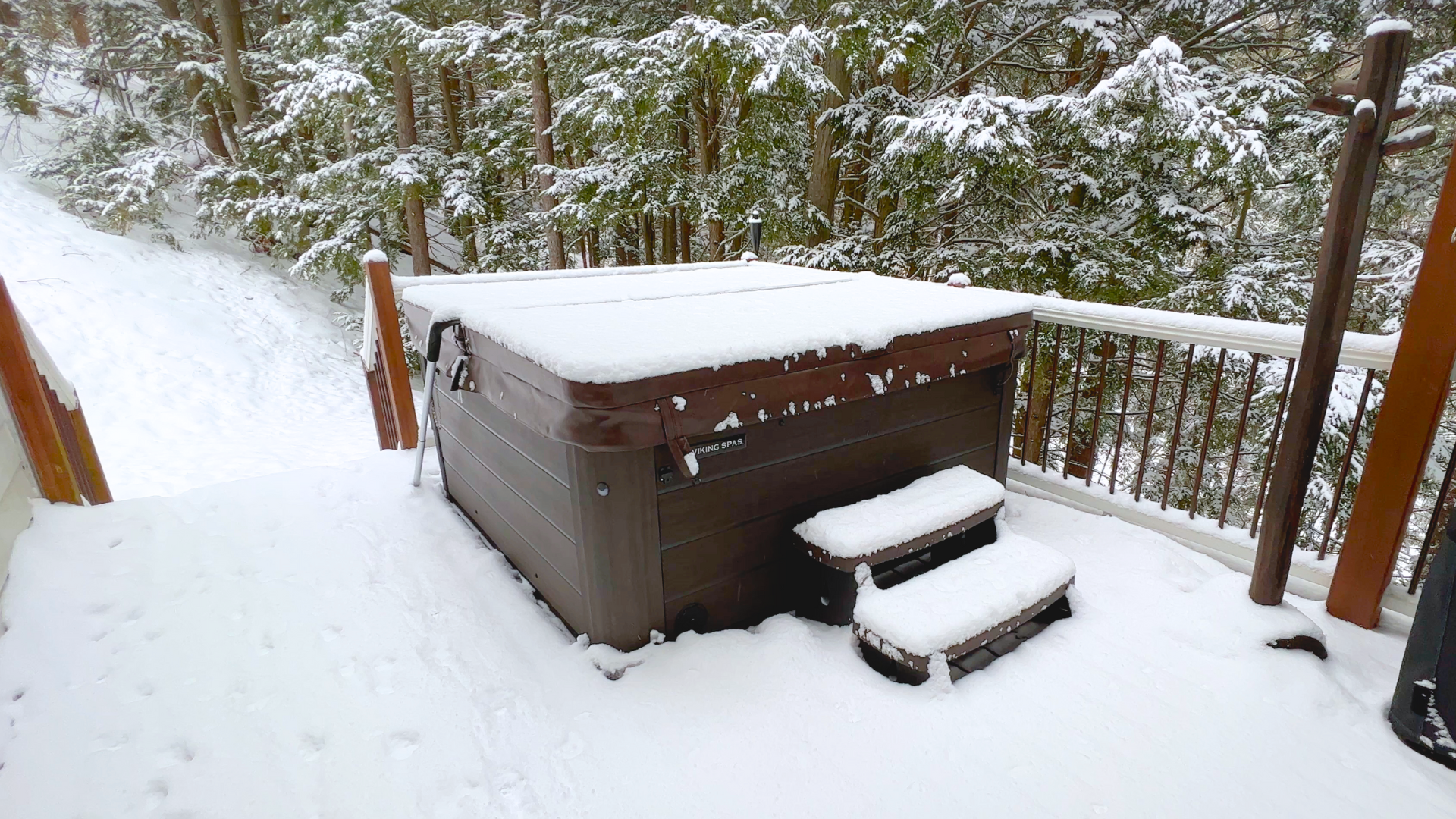
- Protect your cover from snow and ice buildup
- Use a floating thermal blanket under your main cover
- Install windbreaks if your hot tub is exposed to wind
- Check for a waterlogged or damaged cover and replace it immediately
Regular Maintenance
- Keep your filter clean
- Balance your water chemistry regularly
- Clean your cover to prevent mold and damage
- Replace worn-out covers right away
Key Takeaways
- Average winter costs of running a hot tub range from $30 to $60 per month
- Insulation, pump type, outside temperature, usage frequency, and local electricity rates all impact your costs
- Calculate your costs using wattage, run times, and electricity rates.
- Keep your hot tub running instead of turning it off
- Maintaining a steady temperature of 80°F (27°C) is more cost-effective than repeatedly reheating cold water
- Invest in proper insulation and cover maintenance
- Keep your filter clean and water balanced
3 Ways We Can Help With Your Hot Tub
- Hot Tub Cheat Sheets (Free): Easy-to-use guides to help you keep your hot tub water balanced and sanitized.
- The Hot Tub Handbook: An illustrated guide to DIY hot tub care, including water chemistry, maintenance, troubleshooting, and more.
- The Hot Tub Care Course. You’ll get step-by-step videos and a step-by-step downloadable guide with everything you need to know about hot tub maintenance.