


How to Shock a Pool The Right Way
 Matt Giovanisci
  May 5, 2026
 If your pool water looks murky or is starting to turn green, it’s probably time to shock it. Shock is one of the most powerful tools in your pool care routine. But if you add it wrong, you can waste money, damage your pool, or end up with water that’s still a mess.
Once you understand how shock works and which type to use, the process is pretty straightforward. Watch the video below or keep reading for everything you need to know about how to shock a pool the right way.
This is the ultimate guide to keeping your pool sparkling clean throughout the year that contains everything you need to know about taking care of your pool the right way. Including saltwater pools.
What Does Shocking a Pool Actually Do?
Shocking means adding a concentrated dose of chlorine (a.k.a. chlorine shock) to your water to raise your free chlorine levels high enough to overwhelm and destroy contaminants. Shocking is not only the most effective way to kill algae, bacteria, and contaminants, but it also breaks apart combined chlorine, or the used-up chlorine in your water. Combined chlorine in the water, also called chloramines, causes eye irritation and that strong “chlorine smell” in the water.
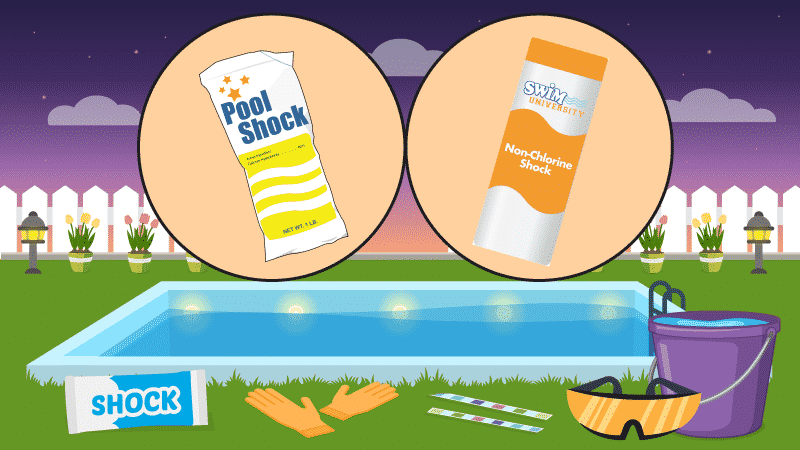
Non-chlorine shock, or oxidizer, is another form of shock that can help keep your pool sanitary. It doesn’t directly kill contaminants or raise your free chlorine levels, but it does help break apart combined chlorine.
When using chlorine shock, the goal is to reach something called breakpoint chlorination. That’s when you raise your free chlorine levels to at least 10 times the amount of combined chlorine in the water. At that point, the chlorine shock breaks apart the molecular bonds in contaminants such as algae and bacteria.
Are Shock and Chlorine the Same Thing?
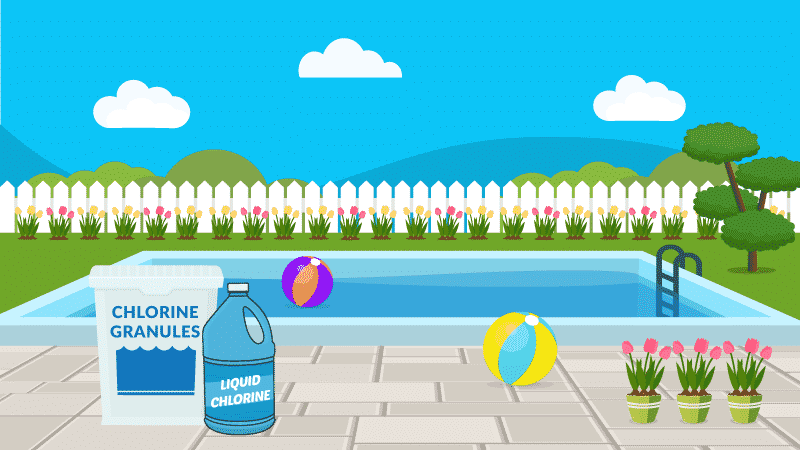
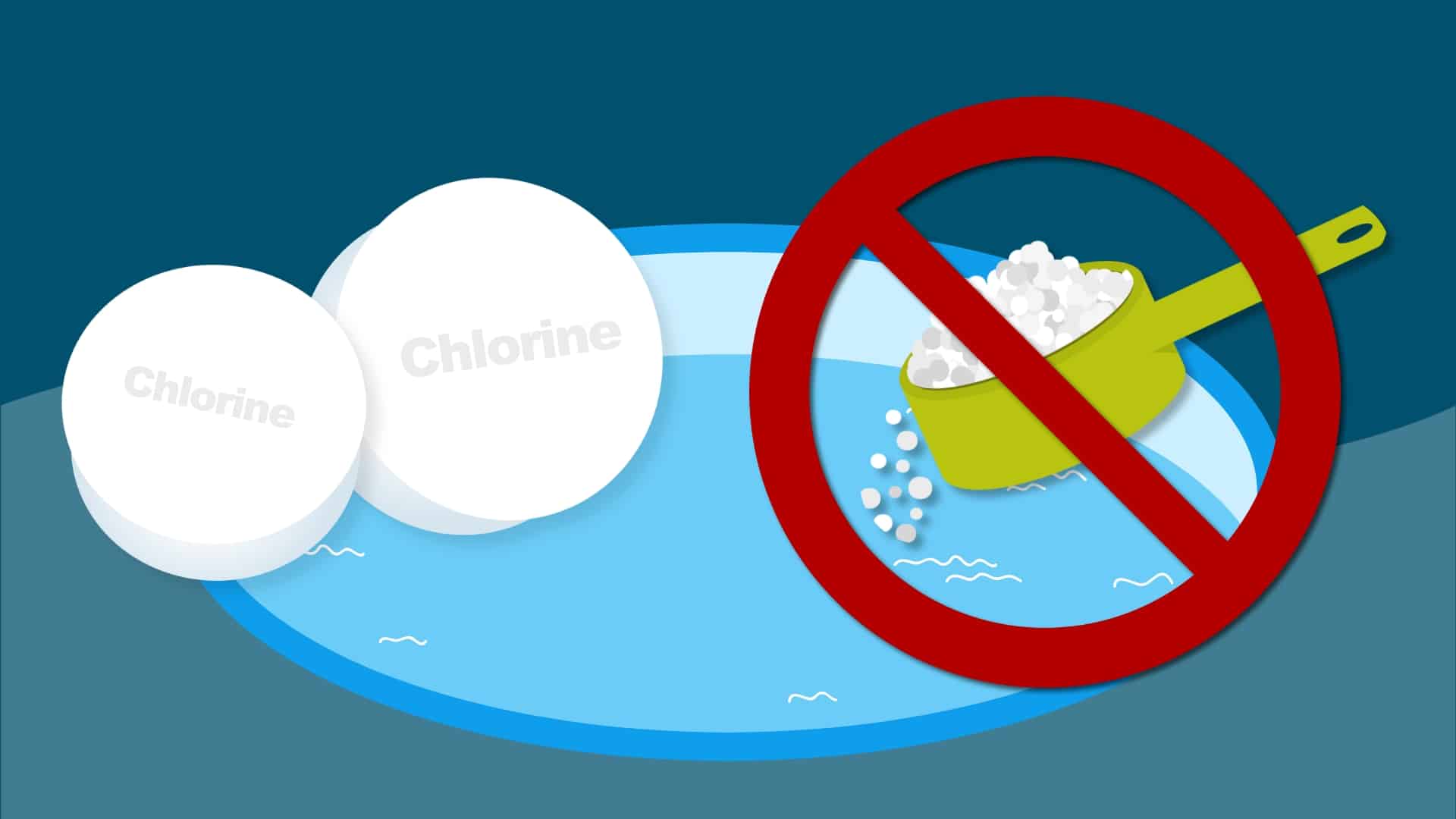
The difference between shock and regular chlorine is the rate at which they raise your chlorine levels. Shock is made to spike your chlorine levels quickly and dissipate after 24 hours. Regular chlorine, like the kind found in tablets or granules, is meant to dissolve slowly and steadily to maintain your chlorine levels over the week.
So shock delivers a powerful spike to overwhelm contaminants, while regular chlorine provides a steady dose to keep your chlorine in range.
Use chlorine tablets or granules for weekly maintenance, and use chlorine shock as your emergency response tool.
What’s the Right Type of Pool Shock to Use?
Different types of shock provide different amounts of superchlorination in the water. Choosing the right shock depends on your pool type and the condition of your water. Here are the most common forms of shock.
1. Calcium Hypochlorite (Cal-Hypo) Shock
- Strongest chlorine shock available, with about 65–75% available chlorine
- Best for serious algae problems and heavy-use pool maintenance
- Unstabilized and doesn’t contain CYA; add at night since the sunlight burns it off fast
- Wait at least 8 hours before swimming, then retest your water
- Skip it for fiberglass pools, saltwater pools, and small pools
- Pre-dissolve it in a bucket first to avoid bleaching

This fast-acting, quick-dissolving swimming pool shock kills bacteria, controls algae, and destroys organic contaminants in pools.
Cal-hypo is the strongest chlorine shock available, with about 65–75% available chlorine. It’s the go-to for serious algae problems and heavy-use pool maintenance. Sunlight will burn it off quickly, so always add it at night. And because it’s so powerful, you’ll need to wait at least 8 hours before swimming. Always retest your water before swimming to confirm chlorine levels have dropped back into range.
A few things to watch out for: cal-hypo raises your pH and adds calcium to the water. Avoid using it in fiberglass pools, since it can cause staining and scaling. Salt water pools are also prone to calcium buildup on the salt cell, so avoid using it with salt pools. It can also overchlorinate smaller pools with less than 10,000 gallons (37,850 liters) of water.
If you’re worried about it staining your surfaces or you have a vinyl liner pool, pre-dissolve the shock in a bucket first so the granules don’t settle and bleach your pool surfaces.
2. Sodium Dichlor Shock
- Slightly less powerful, about 56–62% available chlorine
- Dissolves quickly
- Contains built-in CYA (cyanuric acid) stabilizer, so you can add it during the day
- Safe on sensitive surfaces like fiberglass and vinyl
- Doesn’t raise calcium levels and safe for salt water pools
- Requires an 8-hour wait before swimming
- Contains CYA and can raises CYA levels with frequent use

This multifunctional pool shock from Clorox comes in a 12-pack. The algae-fighting granules create crystal clear water by killing bacteria and organic contaminants. It works well for smaller pools and saltwater pools. As a dichlor-based stabilized cholorine shock, it does contain cyanuric acid.
Dichlor shock is slightly less powerful than cal-hypo shock, with about 56–62% available chlorine, but it dissolves faster. It comes with cyanuric acid (CYA) built in, which acts as a stabilizer and protects the chlorine from breaking down in direct sunlight. That means you can add it during the day. Like cal-hypo, you’ll still need to wait at least 8 hours before swimming.
Dichlor is a great choice for saltwater pools and sensitive surfaces like fiberglass or vinyl. Just keep an eye on your CYA levels, since regular use will raise them over time. If your CYA is already high, skip dichlor and choose something else.
3. Non-Chlorine Shock (Potassium Monopersulfate)
- Does not add chlorine
- Works by oxidizing contaminants and breaking up chloramines
- Won’t kill algae on its own, but revitalizes your existing free chlorine
- Less wait time for swimming
- Safe to add during the day, works with any pool type
- Best for weekly maintenance or clearing combined chlorine
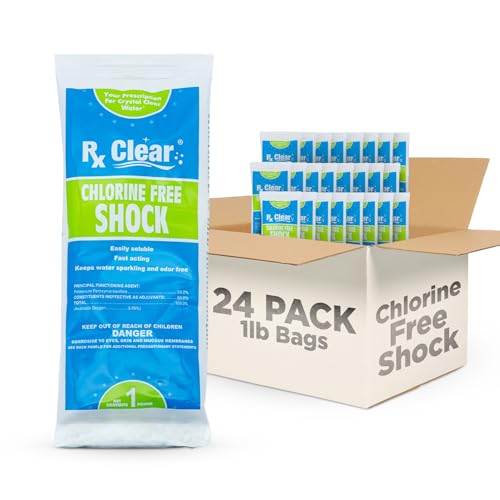
A powerful oxidizing agent that eliminates combined chlorine (chloramines) and provides higher free chlorine levels. Ideal for use with chlorine or bromine-sanitized applications, weekly maintenance, and will not affect other chemical levels
Non-chlorine shock doesn’t contain chlorine, but it works by oxidizing organic contaminants and breaking apart chloramines. It won’t kill algae directly, but it’s excellent for refreshing your free chlorine levels without raising calcium, CYA, or chlorine levels. Adding non-chlorine shock can be enough to kill early-stage algae by revitalizing your existing chlorine.
You can usually swim again in just 15–30 minutes after adding it to your water, but always check the directions on your specific product. Non-chlorine shock works in any pool type and is safe to add during the day. Use this for weekly maintenance or to break up combined chlorine in the water.If you’re not sure if your combined chlorine is high, check out our guide on Total vs. Free Chlorine.
4. Liquid Chlorine (Sodium Hypochlorite)
- Weakest option, about 10–12.5% available chlorine
- Unstabilized; add at night since the sunlight burns it off fast
- Won’t add CYA or calcium to your water
- Ideal for smaller pools and easy to control dosing
- Short shelf life, so buy fresh and use it right away
- Has a high pH, so expect a temporary rise in your pH levels after adding it

For an easy-to-use shock to get rid of algae and cloudy water fast, try using liquid shock.
Liquid chlorine is the weakest of the shock options, with about 10–12.5% available chlorine. It’s unstabilized, so it’ll break down in sunlight. Add it at dusk or night. It dissolves quickly and won’t add calcium or CYA to your water. The trade-off is that it has a very high pH, which will temporarily raise your pH levels.
Liquid chlorine is ideal for smaller pools under 10,000 gallons (37,850 liters) because it’s easier to control the dosing. For large pools, you’d need a lot of it. Also, it has a short shelf life, so buy it fresh and use it right away.
How Much Shock Do You Need?
The standard dose for cal-hypo shock is 1 pound per 10,000 gallons of water (or 454 grams per 37,850 liters). For bigger problems, you’ll need more shock:
- Cloudy water or light green algae: Use a double dose or 2 lbs (0.9 kg) per 10,000 gallons (37,850 liters).
- Dark green algae: Use a triple dose or 3 lbs (1.4 kg) per 10,000 gallons (37,850 liters).
- Black algae or very dark water: Use a quadruple dose or 4 lbs (1.8 kg) per 10,000 gallons (37,850 liters).
If you need help calculating your pool’s volume, use our pool volume calculator.
How to Shock a Pool Step by Step
When adding shock to your pool, follow these steps in order for the most effective treatment.
Before you touch any chemicals, you’ll need chemical-resistant gloves, protective eyewear, and clothing that covers exposed skin.
Step 1: Check Your Filter Pressure
If your filter pressure is 10 PSI above its normal reading, clean or backwash your filter before adding shock. A clogged filter can’t do its job, especially if you’re fighting algae or cloudy water.
Step 2: Test and Balance Your pH
Getting your pH in range helps your shock work more effectively. Your pH should be between 7.4 and 7.6, and your alkalinity should sit between 80 and 120 PPM. It’s okay if your pH is on the lower end, since cal-hypo shock and liquid chlorine will raise it temporarily.
Step 3: Brush Your Pool
Give your pool walls, floor, and steps a thorough brush before shocking. This loosens any algae clinging to surfaces and helps the shock reach everything it needs to.
Step 4: Pre-Dissolve Granular Shock (If Required)
If your shock requires pre-dissolving or if you’re worried about the shock settling on your pool surfaces, pre-dissolve it first. Fill a clean, large bucket that’s about ¾ full of warm water. Then slowly add the shock to the water in the bucket. Always add chemicals to water, not water to chemicals. Stir the shock until dissolved and work in small batches.
Step 5: Add the Shock to Your Pool
For granular shock, walk slowly around the perimeter of your pool and pour the pre-dissolved shock into the water or broadcast the granules evenly across the water surface. If you see any chlorine granules settling on the pool floor, brush them around so they dissolve instead of bleaching the surface. For liquid shock, walk the perimeter and pour it in front of the return jets.
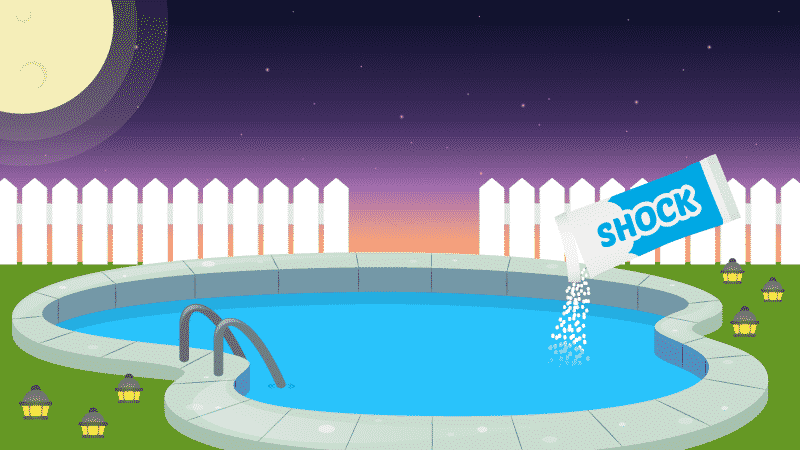
Add cal-hypo or liquid chlorine at night, since the sunlight can burn it off before it has the chance to work.
Never add shock through your skimmer. If you have an automatic chlorinator, mixing shock through the skimmer can trigger a dangerous, potentially explosive chemical reaction. Always add shock directly to the pool water.
Step 6: Run Your Filter
Keep your pump and filter running for at least 8–12 hours after adding chlorine shock. If you used non-chlorine shock, you only need about 15–30 minutes. Check your filter pressure the next day. It may need cleaning or backwashing if it’s picking up contaminants like algae.
If your water is cloudy blue the next day, that means algae has died, and it’s floating in the water. Keep the filter running until it clears up.
Step 7: Repeat as Needed
If the water is still green the next day, it means there’s still algae in the water. Add another round of shock and filter your pool overnight.
Step 8: Retest Before Swimming
Wait until your free chlorine drops back to the safe range of 1–3 PPM before swimming.
How to Shock a Saltwater Pool
Is it okay to shock a saltwater pool? A lot of pool owners think saltwater pools are different from traditional chlorine pools. But the salt in the water passes through a generator which turns it into chlorine. All saltwater pools are actually chlorine pools. The only benefit is that you don’t have to add the chlorine yourself. It’s being generated by your filter system.
This means you can shock your pool using the traditional shock methods outlined in this article. However, we recommend only using Dichlor or non-chlorine shock for saltwater pools.
You don’t always have to shock the pool this way. Most saltwater generators include a “super chlorinate” button that ramps up the production of the chlorine it produces, helping you get to breakpoint chlorination, thereby “shocking” your pool.
And just like a traditional pool, we recommend doing this one a week or every two weeks, depending on weather and usage. For heavy rain and/or high usage, shock your saltwater pool once a week.
When Should You Shock Your Pool?
Shock your pool once a week during swimming season, or at least once every other week if it’s not being used as much. The more your pool gets used, the more often it needs a shock. Use non-chlorine shock to break up combined chlorine, and use chlorine shock if you have problematic water.
In addition to your regular pool care schedule, shock after:
- A pool party or heavy use
- A major rainstorm or high winds that blow in debris
- Free chlorine levels that keep dropping quickly or zeroing out
- Any bodily fluids or food has gotten into the water
How Often Should You Shock Your Pool?
We recommend shocking your pool once a week, or at least once every other week, to maintain sanitized water chemistry properly. The more often you use the pool, the more often you should reach for the swimming pool shock. In addition to your weekly or semi-weekly treatments, you may want to perform an extra pool shock under certain circumstances, such as after:
- heavy pool use (like a pool party)
- a severe rainstorm or damaging winds (especially if your pool collected debris)
- a major water level change
- a bowel-related pool accident
Think of extra shocks as insurance against wayward algae and other contaminants. It’s better to take out any bacteria before it has a chance to affect the quality of your water or make anyone sick.
Pool Shock Safety
Shocking your pool is a necessary part of good maintenance, but please remember those chemicals can be extremely dangerous if they’re mishandled. We’re not exaggerating the danger—improperly stored chlorine can literally explode.
- Never add shock through your pool skimmer, especially if you have an automatic chlorinator. When the shock treatment mixes with the chlorine, it causes a dangerous gas, which can lead to your chlorinator exploding! We’ve seen it happen multiple times.
- Always wear protective gear—especially goggles and chemical-resistant gloves—when handling and dissolving chlorine. Pool shock, especially calcium hypochlorite, can sometimes release small amounts of chlorine gas. Wearing protective gear can help prevent eye and skin irritation.
- Do your best to avoid directly breathing from the containers. Exposure to chlorine gas can cause throat and lung irritation. You probably don’t need a dust mask, just try not to breathe too close to the container. If it makes you feel safer, though, you can use a chemical mask.
- Never, ever mix types of pool shock. We don’t want you to become a home science experiment gone wrong. Mixing liquid chlorine or even dry chlorine granules can cause a volatile reaction. Add each chemical to your pool separately.
- Do not add shock directly to the pool water unless instructed to do so. If the package says dissolve before adding, make sure to do just that.
- Only open one container at a time. If you need to use more than one container of shock, make sure you completely empty out each container before moving on to the next one.
Frequently Asked Questions About Shocking Your Pool
Looking for more help with shocking your pool? Here are some common questions and answers.
Are chlorine and shock the same thing?
No. There are versions of shock that have chlorine, like Calcium Hypochlorite. But some pool shock treatments have no chlorine. However, you can use a high dose of liquid or granular chlorine to shock your pool.
Can I shock my pool without the pump running?
We recommend running your pump and filter when you’re actively shocking your pool and for at least 8-12 hours after. If you don’t run your pump and circulate the water, you run the risk of bleaching your pool walls and floor if you’re using chlorine shock.
Can I swim 12 hours after shocking the pool?
It’s usually safe to swim after letting the shock circulate in the water for at least 8 hours. However, we recommend testing the water’s chlorine level before swimming. A high chlorine reading may be uncomfortable and dangerous to swimmers.
Does pool shock work in cold water?
Yes, but no matter what the temperature of your pool water, we recommend dissolving shock in a bucket of warm water before adding it. This will help dissolve the shock so it doesn’t sit on the bottom of your pool and cause bleaching. Plus, it helps it to mix into the water better and faster.
Key Takeaways
- Shocking raises your free chlorine to breakpoint chlorination, which destroys chloramines, bacteria, and algae.
- Shock and regular chlorine are not the same thing. Shock delivers a powerful one-time dose while chlorine tablets maintain daily sanitizer levels.
- The right type of shock depends on your pool: use cal-hypo for power, dichlor for saltwater and fiberglass, non-chlorine for quick turnaround, and liquid chlorine for small pools.
- The standard dose of cal-hypo shock is 1 lb (454 g) per 10,000 gallons (37,850 L). Use a double or triple dose for algae.
- Add shock at night and run your filter for 8-12 hours as it works in the water.
- Never add shock through your skimmer. Always add it directly to the pool water.
- Test your water before swimming and wait until free chlorine is back to 1–3 PPM.