


Pool Volume Calculator (For All Shapes and Sizes)

Do you need to figure out the water capacity of your pool? Just enter your pool’s measurements into our pool volume calculator below. 👇
Pool Volume Calculator
Pick your pool shape and enter its dimensions. The volume updates as you type.
 Save this in The Pool Care App
Note: Be sure to measure from the depth of your water, not the height of the wall or the depth of the pool. You want to know how much water is in your pool, and it’s probably not filled up to the top. The calculator rounds up decimal points, which makes it easier to calculate chemical dosing. But the rounding isn’t enough to throw off your water chemistry calculations.
If your pool is more complicated, you’ll need to run a few other calculations. At the end of this guide, we cover how to calculate the volume of an irregular-shaped pool.
You can use the pool volume reference chart below to calculate the volume of these common pool sizes quickly.
Inground Pool Sizes (Average Depth)
| Pool Size | Gallons | Liters |
|---|---|---|
| 12×24 Rectangular (3.7×7.3 m) | 10,800 | 40,882 |
| 16×32 Rectangular (4.9×9.8 m) | 19,200 | 72,680 |
| 16×36 Rectangular (4.9×11.0 m) | 21,600 | 81,765 |
| 18×36 Rectangular (5.5×11.0 m | 24,300 | 91,986 |
| 20×40 Rectangular (6.1×12.2 m) | 30,000 | 113,562 |
| 16×32 Oval (4.9×9.8 m) | 17,200 | 65,109 |
| 18×36 Oval (5.5×11.0 m) | 21,700 | 82,143 |
| 20×40 Oval (6.1×12.2 m) | 26,800 | 101,449 |
| 17×33 Grecian (5.2×10.1 m) | 19,700 | 74,573 |
| 17×37 Grecian (5.2×11.3 m) | 22,200 | 84,036 |
| 20×36 Grecian (6.1×11.0 m) | 24,300 | 91,986 |
| 20×44 Grecian (6.1×13.4 m) | 30,300 | 114,698 |
| 16×30 Kidney (4.9×9.1 m) | 14,900 | 56,403 |
| 16×34 Kidney (4.9×10.4 m) | 16,500 | 62,459 |
| 20×38 Kidney (6.1×11.6 m) | 20,200 | 76,465 |
Above Ground Pool Sizes (52″ Wall Height (132 cm))
| Pool size | Gallons | Liters |
|---|---|---|
| 15′ Round (4.6 m) | 5,800 | 21,955 |
| 18′ Round (5.5 m) | 8,300 | 31,419 |
| 20′ Round (6.1 m) | 10,200 | 38,611 |
| 24′ Round (7.3 m) | 15,300 | 57,917 |
| 27′ Round (8.2 m) | 18,600 | 70,409 |
| 28′ Round (8.5 m) | 20,000 | 75,708 |
| 11×25 Oval (3.4×7.6 m) | 7,000 | 26,498 |
| 15×25 Oval (4.6×7.6 m) | 8,400 | 31,797 |
| 15×30 Oval (4.6×9.1 m) | 9,600 | 36,340 |
| 18×33 Oval (5.5×10.1 m) | 11,500 | 43,533 |
| 18×38 Oval (5.5×11.6 m) | 15,200 | 57,539 |
Note: These are estimates. You’ll always get more accurate results if you measure your pool yourself. And always measure the depth of your water, not the height of your wall.
How to Calculate Pool Volume Step-By-Step
If you need to calculate the volume of an irregular-shaped pool or you’re still feeling confused, check out our video that walks you through how to calculate the volume of water in your pool. Or keep reading for a complete walk-through of these calculations.

Enter your water test results. Get a custom treatment plan. Know exactly what chemicals to add to keep your pool clear. Saltwater and hot tub compatible.
Pool Volume Calculation Basics
To get your pool’s volume, you need to calculate your pool’s surface area and average depth. And to do that, you’ll need a few basic metrics:
- Length (L)
- Width (W)
- Depth (D) or Height (H)
- Diameter (d) (for round pools)
- Radius (r) (for round pools)
- Pi (3.14 constant)
Multiply the length and width to get the surface area of a rectangular pool. Then, add your pool’s depth, and you’ll get a basic volume calculation.
Another key part of your equation: one cubic foot of water contains 7.5 gallons. So, in order to figure out how many gallons your pool holds, you’ll multiply your final cubic foot measurement by 7.5 to find the volume of your pool.
Let’s see what this looks like with different pool shapes.
Rectangular Pool Volume
How you calculate your volume will depend on how the bottom of your pool is laid out.
Constant Depth
The formula for finding the volume of a rectangular pool with one depth (no shallow or deep end) is L × W × D × 7.5 = V (in gallons).
For example, if your swimming pool is 32 feet long, 16 feet wide, and 4 feet deep:
- 32 × 16 × 4 × 7.5 = 15,360 gallons
Variable Depths with a Gradual Slope
If your rectangular pool has more than one depth (shallow end, deep end), you’ll need to do a little more math. First, determine the pool’s average depth. Add the shallow end depth to the deep end depth, and divide by 2.
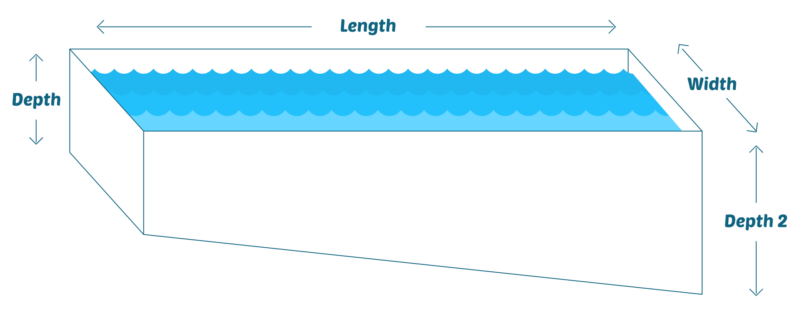
For example, if your pool’s shallow end is 3 feet and the deep end is 9 feet, the average depth is 6 feet.
Next, multiply your pool’s length and width by the average depth. Finally, multiply that figure by 7.5 to calculate the pool’s volume in gallons.
For example, if your pool is 32 feet long, 16 feet wide, and has an average depth of 6 feet:
- 32 × 16 × 6 × 7.5 = 23,040 gallons
Variable Depths with a Drop-Off
If your pool has a definitive drop between the shallow and deep ends, the average depth will be different, even if the shallow end and deep end are still, for example, 3 feet and 9 feet, respectively.
Treat the shallow and deep ends as separate pools. This will allow you to apply the volume of each section using the constant depth formula.
Once you have the volumes of both parts, add them together to determine the volume for the whole pool.
Round or Circular Pool Volume
The formula for finding the volume in gallons of a round pool is 3.14 × r2 × D × 7.5 = V (in gallons)
Start by measuring your pool’s diameter, which is calculated at its widest point across (i.e., your pool’s length). Then, divide the diameter by 2 to get the radius.
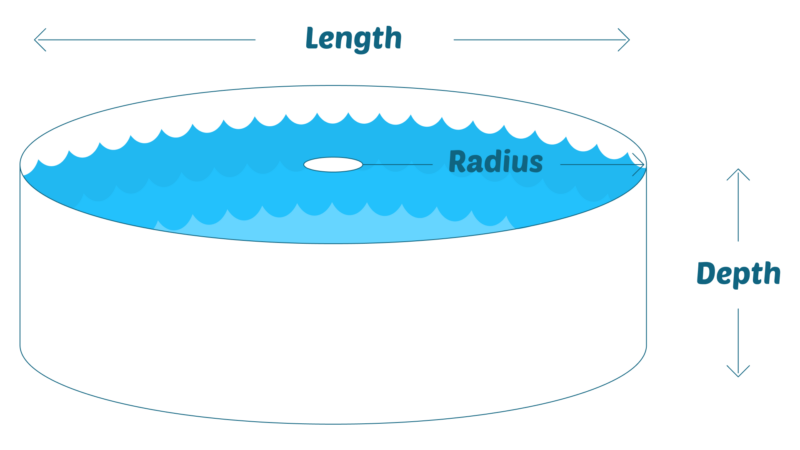
Your radius squared is the radius multiplied by the radius. Finally, measure the pool’s depth.
For example, if your pool’s diameter is 18 feet, your radius is 9 feet, and your depth is 4 feet:
- 3.14 × (9 x 9) × 4 x 7.5 = 7630.2 gallons
Irregular-Shaped Pool Volume
If you have an oval, kidney shape, or other irregular-shaped pool, you can still calculate the volume. You’ll have to do even more math.
The easiest way to calculate an oddly shaped pool is to imagine it broken down into two or three smaller, regularly shaped parts. Try to see smaller, individual squares, rectangles, or circles within the larger, irregular shape.
Once you’ve mapped them out, measure each part. Then, use the same formula above to calculate the volume of each smaller section. Finally, add all the volume figures together, and you’ll have a pretty close approximation of the pool’s total volume.
When To Ask a Professional to Measure Your Pool
If the swimming pool volume calculator or calculations don’t work properly for you because you have an unusual pool shape or you want everything to be more accurate, ask a pool professional to take the measurements and figure out the volume for you.
Remember, before you add chemicals to your pool water, you need to know how many gallons of water are in it. Knowing your pool volume is critical for adding the right amount of chemicals and is absolutely necessary if you’re installing a new pool pump, pool filter, or pool heater. Keep these calculations handy for future reference—you’ll need them often as a pool owner!
Key Takeaways
- Knowing your pool’s volume in gallons is essential before adding chemicals, sizing a pump, or installing a new filter or heater.
- For a rectangular pool with constant depth, use the formula: Length x Width x Depth x 7.5 = Volume in gallons. One cubic foot of water holds 7.5 gallons (28.4 liters).
- If your pool has a shallow end and a deep end, find the average depth first by adding both depths together and dividing by 2.
- For round pools, use the formula: 3.14 x radius² x Depth x 7.5 = Volume in gallons.
- For irregular-shaped pools like ovals or kidney shapes, break the pool into smaller sections of basic shapes. Then calculate each section separately and add the totals together.
- Always measure the actual water depth, not the wall height. Your pool likely isn’t filled to the top, so wall measurements will overestimate your volume.