


Filter Glass vs. Sand: Which Pool Filter Media is Better?

If your sand filter is getting older, you might be wondering whether it’s worth sticking with traditional sand or switching to glass. Glass media has been gaining traction with pool owners who want cleaner water and less maintenance. It filters better and lasts longer as sand. But it’s more expensive, and it might be worth switching to a new filter altogether.
So, is it worth using filter glass? Here’s what you need to know before dumping out your sand and buying a bag of glass for your pool filter.
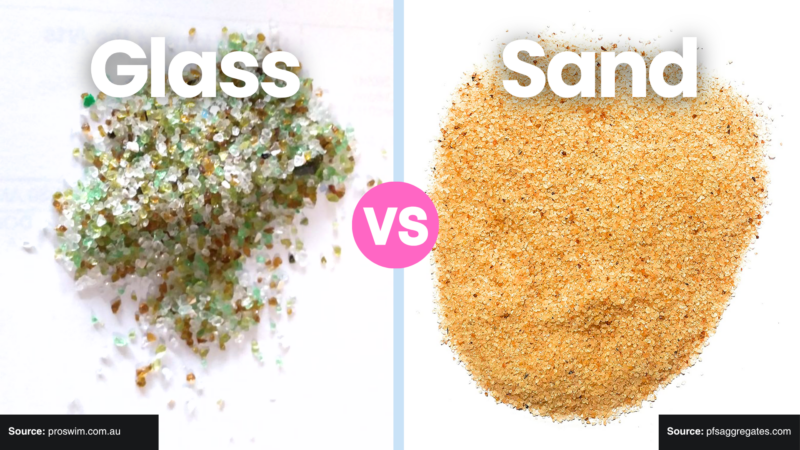

Made from recycled glass, this filter media catches tiny particles much better than sand, lasts way longer, and helps keep your pool water crystal clear while saving water during backwashing.
How Well Does Glass Filter Your Water vs. Sand?
When it comes to filtering power, glass outperforms sand. It can capture smaller particles more efficiently than sand.
Traditional sand filters particles down to about 20–40 microns. Glass media, on the other hand, can filter down to 3–5 microns.
Traditional sand also has a tendency to “channel,” which means water can carve paths through the sand where it won’t get filtered. Glass doesn’t do that. Glass is also less dense than sand, so it doesn’t pack together as tightly, helping it filter better.
Glass also carries a slight negative charge that attracts fine particles, especially the ones that sand would simply let slide through. The result is noticeably clearer water.

Our perfectly sized pool filter sand filters out insects, leaves, dirt, dust, sunscreen oiled, hair & other small particles to keep your pool sparkling clean. This pool filter sand is specifically designed to meet the standards for all brands of pool filters.
How Long Does Glass Media Last in a Pool Filter?
This is one of the biggest advantages of glass media. Glass usually lasts 8 to 10 years. Well-maintained systems can sometimes last 10 to 15 years, since glass doesn’t degrade, cement doesn’t crumble, and sand doesn’t break down.
Compare that to traditional silica sand, which needs to be replaced every 3–5 years. Even zeolite (another popular sand alternative) only lasts around 4–6 years. Over time, the higher upfront cost of glass starts to even out.
When you do switch to glass, you’ll also use about 15% less media by weight compared to sand. That’s less material to buy, less to haul, and less to dispose of.
Does Filter Glass Media Require Less Maintenance?
Yes, but with some nuance. You’ll still need to backwash glass in your pool filter, but not as often as you would with sand. And when you do backwash, the cycle is typically shorter. With a shorter backwash cycle, you’re wasting less water.
You should still plan to deep-clean your filter with a sand filter cleaner once a year, regardless of what media you’re using.
How Often Should You Backwash a Glass Media Filter?
With traditional sand, a common rule of thumb is to backwash when your filter pressure rises about 10 PSI above normal. Glass media generally extends the time between those pressure spikes.
The exact frequency depends on how much your pool gets used, how heavy the debris load is, and how dirty your water is. Check your pressure gauge once a week and backwash whenever it climbs 10 PSI above your normal clean reading. With glass, you’ll just find yourself doing it less often.
Is Glass Media Better Than FilterBalls?
Both are solid upgrades over traditional sand, but they work differently. FilterBalls filter down to 5–15 microns, which is still better than sand, but not quite as fine as glass media at 3–5 microns.
FilterBalls are much lighter and easier to handle than both glass and sand. They also have a higher flow rate, which reduces wear on your pump. However, they only last about 4–5 years before needing replacement.
Glass media filters better and lasts significantly longer than FilterBalls. If water clarity is your top priority and you don’t mind paying more upfront, glass wins. If you want easier handling and good (not perfect) filtration, FilterBalls are a good choice. Both filter better than traditional sand.

Filter Balls to be super easy to manage, 100x lighter than sand filter media and it improved circulation and filtration, with lower filter pressure and higher flow rate. Eliminate hauling and disposal of hundreds of pounds of sand.
Should You Upgrade to a New Filter Instead of Buying Glass?
If you’re going to invest in better filtration, a cartridge filter system is worth considering instead of upgrading your sand filter’s media.
Cartridge filters filter better than sand filters, and there’s no backwashing involved. The multiport valve on a sand filter does create some flow restriction that a cartridge system avoids. If you’re already considering a major equipment upgrade, it’s worth comparing both options side by side.
But glass is still a more powerful filtration option than a cartridge filter. So if your sand filter is in good shape and you’re not ready for a full system replacement, switching to glass media will help your pool filter water better than sticking with sand.
Where Can You Buy Glass Media for Your Pool Filter?
Glass pool filter media is available online and at specialty pool retailers. It’s typically sold in 40 lb (18 kg) bags, with prices ranging from $35 to $50 per bag.
Because glass is lighter than sand, you’ll need about 15% less by weight to fill the same tank. If you’re unsure how much to order, check your filter’s manual.
Made from recycled glass, this filter media catches tiny particles much better than sand, lasts way longer, and helps keep your pool water crystal clear while saving water during backwashing.
Key Takeaways
- Glass media filters down to 3–5 microns, compared to 20–40 microns for traditional sand. This significantly improves water clarity.
- Glass media lasts 8-10 years or more, while standard sand needs replacing every 3–5 years.
- You’ll backwash less often with glass, and each backwash cycle uses less water.
- Glass costs more upfront, but the longer lifespan and reduced maintenance make it a better long-term value for most pool owners.
- FilterBalls are a lighter, more convenient alternative to glass, but glass filters more finely and lasts longer.
- If you’re considering a major upgrade, compare using glass to a cartridge filter. Cartridge filters require no backwashing and filter better than sand, but glass still filters better than both.