

Pool Chlorine Calculator and Dosing Guide
 Matt Giovanisci
  July 28, 2026
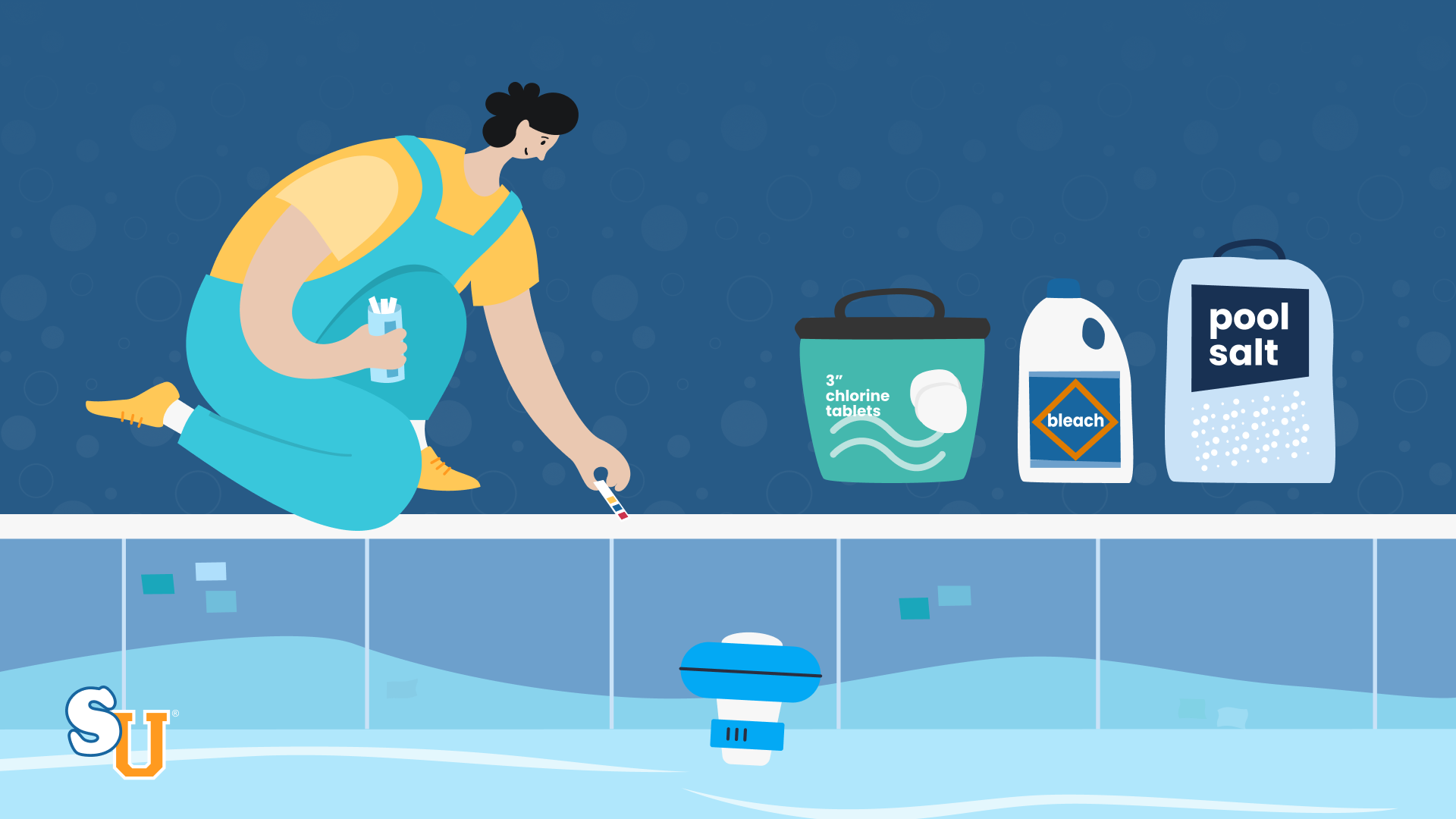
 As a general rule, pool owners need to keep the chlorine level between 1-3 ppm (parts per million). That matches CDC advice. And there are 4 ways to get chlorine into your pool:
- Liquid chlorine or bleach (sodium hypochlorite)
- Granular/powered chlorine (dichlor or calcium hypochlorite)
- Chlorine tablets (trichlor)
- Salt water chlorine generator (SWG)
We’ve built a pool chlorine calculator that uses your pool volume to estimate how much chlorine to add, so you can get the right sanitizer dose without guessing.
Free Chlorine Calculator
Pick the type of chlorine you’re adding and enter your numbers. The dose updates as you type.
 Get exact doses in The Pool Care App
→
Get exact doses in The Pool Care App
→
You do not need to know how strong your chlorine product is. We fill in good defaults. Results come in cups and ounces, in both US and metric.
Note: Chlorine is more effective when your pH level is between 7.2 and 7.6. And you should keep your total alkalinity between 80-120 ppm (this helps keep your pH balanced).
How The Pool Chlorine Calculator Works
There is one more box for your current cyanuric acid (CYA) level. CYA protects your chlorine from being “burned off” too quickly by the sun’s UV rays before it has a chance to really sanitize the water. You can think of it like a sunscreen for your chlorine.
But too much cyanuric acid overprotects your chlorine. Meaning you’ll have to add more chlorine to compensate for the high CYA.
The 7.5% CYA Rule
CYA (cyanuric acid) is like sunscreen for your chlorine. It keeps the sunlight from burning your chlorine off too fast. This is a good thing. But too much will overprotect your chlorine, and you’ll need to compensate by adding more chlorine. Thankfully, there’s an equation…
Your pool should have at least 7.5% of the amount of chlorine to your CYA level. For example, if your pool has 100 parts of CYA, you need at least 7.5 parts of free chlorine. The pool chemical calculator above does the math for you. But to make it easier, take your CYA level and divide it by 13. That lands you just above 7.5%, which is slightly more chlorine.
- CYA 30 ppm → 2-3 ppm chlorine
- CYA 40 ppm → 3 ppm chlorine
- CYA 50 ppm → 4 ppm chlorine
What Are the Different Types of Pool Chlorine?
- Liquid pool chlorine is the same as bleach, but roughly double the strength. It’s about 12% percent sodium hypochlorite, while bleach is about 6%. It comes in 1-gallon (3.8 L) and 5-gallon (19 L) jugs. It does not contain cyanuric acid (CYA).
- Granular chlorine is a coarse powder. It is about 60% dichlor chlorine and dissolves fast. This product contains CYA.
- Trichlor Tablets, or pucks, are the strongest at up to 90%. They dissolve slowly, which is great for hands-off use in a chlorinator, floater, or your skimmer basket. Contains CYA.
- Chlorine Shock (cal hypo). A granular 60-70% calcium hypochlorite-based chlorine product is usually sold in 1-pound bags. It does not contain CYA. Save it for problems like algae when you need to jack up your chlorine really high. It is not every day chlorine.
- Salt: Plain table salt in your pool water passes through a saltwater chlorine generator (SWG) that gets converted into natural chlorine (hypochlorous acid).
What Is the Difference Between Stabilized and Unstabilized Chlorine?
Stabilized chlorine has CYA in it. Unstabilized chlorine does not. Trichlor tabs and dichlor granules are stabilized. Liquid chlorine and Cal Hypo shock are not. You can read my full guide on stabilized vs unstabilized chlorine here.
Every time you add tablets or granules, you add CYA too. Too much CYA makes your chlorine weak. The CDC says high CYA means you need more chlorine to do the same job.
Without CYA (chlorine stabilizer or pool conditioner), you can lose about 90% of your chlorine’s effectiveness in about two hours.
What Is the Difference Between Free, Combined, and Total Chlorine Readings?
- Free chlorine is the chlorine still working as your sanitizer in pool water.
- Combined chlorine is chlorine that has bonded with contaminants to form chloramines.
- Total chlorine is the sum of those added together.
Free chlorine is the good stuff that kills bacteria. Keep it between 1 and 3 ppm. Combined chlorine causes a strong “pool smell” and red eyes. Keep it at 0.5 ppm or lower for effective sanitation.
For example, if your free reads 1 ppm and your total reads 2 ppm, that means your combined chlorine is 1 ppm. That is too high.
When Combined Chlorine is above 0.5 ppm, shock the pool to breakpoint chlorination to oxidize contaminants (or use a non-chlorine shock if your free chlorine is already in range). You want free and total chlorine readings to match. Check out the full guide on free chlorine vs total chlorine here.
What Is the Best Way to Add Chlorine to Your Pool?
The easiest setup is a salt system. If you cannot use salt, use tablets in a feeder. Here is how I rank every method.
- If I could spend freely, I would use salt. A salt system makes its own chlorine while the pump is running. It is the most hands-free way to go. You just keep the salt level around 3,200 ppm. For comparison, the ocean contains 35,000 ppm of salt.
- No salt? Then I use tablets in a feeder (chlorinator). Set the dial to about half to start. Test the water. Then turn it up or down until it holds.
- No feeder? I’d use granular or liquid chlorine by hand.
- After that, I would put tablets in the skimmer basket before a floater. Just run the pump all day if you do. Floaters spread chlorine in an uneven way and get stuck on the ladder. That can bleach your liner. I know this can damage your system in the long run, so I would only do this in a pinch.
A common problem with using tablets and dichlor is CYA creep. When my CYA climbs near 80 ppm, I stop tablets for a month and switch to liquid chlorine to let the CYA drop. I do not add any more stabilizer.
How Do You Add Chlorine to a Saltwater Pool?
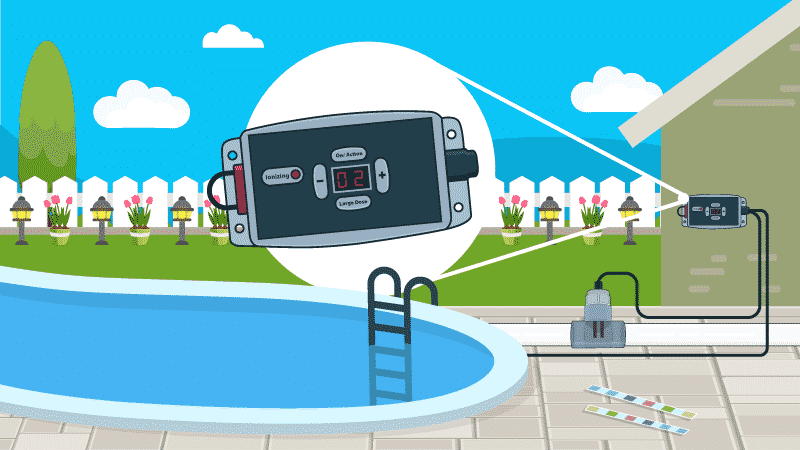
For a salt pool, you do not pour chlorine. You set your salt system’s output level. Start near 20 percent and turn it up if you need more. Test your free chlorine and adjust. Here’s my full guide on saltwater pool care.
Every pool and climate is different. There is no magic setting. A hot pool with kids in it every day needs more than a cool, quiet one. Testing tells you where to land.
When should a salt pool owner still use liquid chlorine? Only for a problem, and that means algae. For a little cloudiness, hit the super-chlorinate button. For a green pool, use liquid chlorine or a shock. Watch your calcium so it does not build up in the cell.
How Do You Add Chlorine Safely?
To stay safe, always pour chemicals into water, not water into chemicals. Never mix different chlorine types, because dangerous reactions can happen. Run the pump while you dose.
Never mix two chlorine products. Tablets and shock can react hard if they touch. Chlorine and acid can make a toxic gas.
Store liquid chlorine somewhere cool and dark. Buy it fresh, since it loses strength fast. One more tip. Granular is measured by weight, and liquid by fluid ounces, so use the right testing and dosing equipment when measuring and adding chemicals. Do not mix those up.
Do You Need to Shock Your Pool Every Week with Chlorine?
You DO NOT need to shock every week if you test your water often enough. Technically, you only need to shock when combined chlorine climbs above 0.5 ppm, or you see algae. Your routine should be testing, not shocking.
Still, testing takes work. Not everyone wants to fuss with it. If you like things simple, a weekly non-chlorine shock is a fine backup. This is why I recommend weekly or bi-weekly shocking for most pool owners who just want to make life easy. Here’s how to shock a pool the right way.
For a pool under 20,000 gallons (75,700 L), that is about two bags a week in summer. It is easy, and you do not have to think about it. You can also swim soon after.
Should You Trust Pool Store Advice?
Take pool store advice cautiously. The staff is often new each season, and the water testing software they use is most likely built by the chemical company they carry. I worked at pool stores for years, so I know this.
They hire a new batch of people every summer. Most never get much training because there isn’t enough time before pool season is in full swing.
That said, I recommend buying all your chemicals from your local pool supply store to support them. Then put your numbers into this tool or the app to get the real dose.
Key Takeaways
- Keep free chlorine between 1 and 3 ppm. Add your CYA if you want the tool to set your target.
- Tablets and granules add CYA. Switch to liquid when your CYA climbs near 80 ppm.
- Salt pools use the same chemistry. You set it with the salt system’s output level.
- Testing tells you everything. Test weekly with a liquid kit, and use strips for a quick check.