

The Best Pool Test Kit For Saltwater Pool Owners in 2026
 Matt Giovanisci
  March 30, 2026
 Your salt water generator has a built-in salinity display, but a dirty salt sensor or low water temperature can throw off the numbers. Salt water pools are also notorious for chronically high pH and sensitivity to high calcium hardness levels. So what’s the best test kit to keep your salt water pool balanced and sanitized?
You’ll need a pool test kit that includes both salinity readings and accurate measurements of pH, total alkalinity, free chlorine, total hardness, and cyanuric acid.
This is the kit we recommend:

This complete water testing kit helps keep your pool or hot tub clean and safe to swim in, with easy-to-follow color instructions and all the supplies you need in one box.
This is the most comprehensive way to test the water chemistry of your salt water pool. If a saltwater test kit is out of your budget, you can test the water with regular test strips and supplement it with saltwater test strips or a digital salinity reader.
Keep reading for an explanation of the three testing options. Each method has its own strengths depending on your budget, how often you test, and how precise you need to be.
Are There Special Test Strips for Salt Water Pools?
Standard pool test strips work for salt water pools, since they measure things like pH, free chlorine, total alkalinity, and calcium hardness. However, they don’t measure salinity. Specialty salt water strips must be purchased separately from your regular test strips. If you own a salt water pool and plan to use test strips, you’ll want two types of test strips on hand: one set for your weekly chemistry checks and another set for your monthly salinity checks.
1. Liquid Salt Water Test Kit (Our Pick)
This complete water testing kit helps keep your pool or hot tub clean and safe to swim in, with easy-to-follow color instructions and all the supplies you need in one box.
A liquid reagent test kit offers more precise results than test strips, and the salt water kits test for salinity. You’ll fill the included vials with pool water, then add the reagent drops according to the manufacturer’s instructions. The samples change color based on your levels. Look for a kit that tests for:
- Free chlorine
- Combined chlorine
- pH
- Total alkalinity
- Acid or base demand
- Calcium hardness
- Cyanuric acid (CYA)
- Sodium chloride (salt)
Liquid test kits require more effort than dipping a strip. You need to measure the drops carefully, since adding too many or too few can skew your results. For better accuracy, hold the vial up against a white background when comparing colors.
How to Collect a Water Sample for Liquid Testing
Getting accurate results starts with a proper water sample. Take the sample from as close to the middle of your pool as possible. Stay away from the skimmer and return jets.
Using a clean cup, hold it upside down so the opening faces the pool floor. Then insert the cup into the water about elbow deep, roughly 18 inches (45 cm). Turn it right side up to collect the sample. Now you’re ready to add your reagent drops and check the results.
2. Salt Water Test Strips
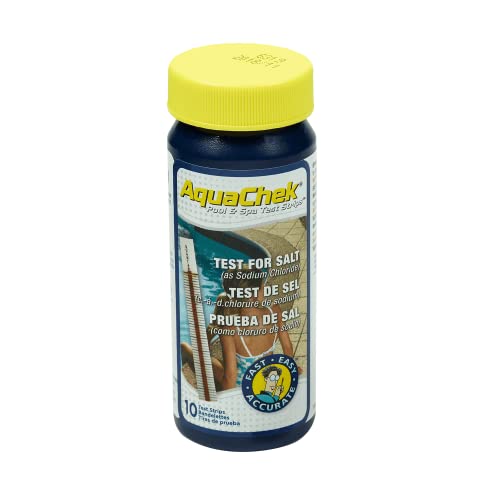
These salt test strips are designed for measuring sodium chloride levels from 400 to 7,000 ppm. They provide accuracy comparable to liquid tests without the hassle of measuring and counting drops.
Salt water test strips are the most affordable option for checking your salinity, especially if you already have regular test strips on hand for your weekly chemistry checks. Dip the strip in a water sample and wait several minutes for the results. The strip pads change color based on your sodium chloride levels.
Most salt water test strips measure sodium chloride levels from 400 to 7,000 PPM. That range covers the typical salt water pool target of 3,200 PPM with plenty of room on either side.
Test strips aren’t as precise as liquid test kits or digital testers. However, they’re a cheap and convenient way to get an approximate reading to check against your salt water generator. Keep in mind that test strips can become contaminated if left unsealed or exposed to moisture.
Tips for Accurate Test Strip Results
First, remove one test strip from the bottle without touching the strip pads. Then dip the strip into your pool water about elbow deep, roughly 18 inches (45 cm). Remove it quickly. You don’t need to leave it in the water for long.
Next, shake once to remove excess water. Hold the strip still for 15 to 30 seconds as the colors develop. Finally, compare the strip’s colors to the chart on the packaging.
For the most accurate results, take your water sample from the middle of your pool. Do not test near the skimmer or return jets, as those areas can yield readings that aren’t representative of your overall water.
3. Digital Salinity Tester
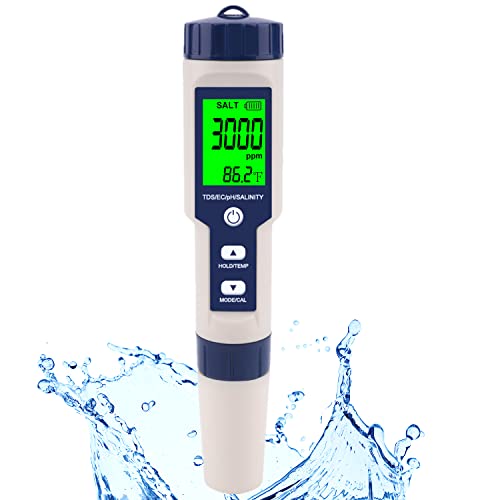
This Digital Salinity Tester is an accurate, easy way to verify the salt levels in your pool. Simply place the tester in your pool water for a digital salinity reading.
A digital salinity tester is the most accurate way to test your pool water. Simply place the tester directly in your pool water and wait for a digital readout. No color matching, no guesswork, no squinting at tiny color charts.
Most digital testers also measure total dissolved solids (TDS) and total hardness. This is helpful since saltwater pools have a higher ideal TDS range of 5,000 to 6,000 PPM. Knowing your TDS, along with your salinity, gives you a more complete picture of your water quality.
Digital testers are especially useful if you have trouble distinguishing between colors on test strips or liquid kits. The readout is clear, which makes testing faster and more reliable.
What Is the Best Way to Test a Saltwater Pool?
A digital salinity tester is the most accurate way to test for salinity because it eliminates the guesswork of color matching. You get a precise number on a screen instead of trying to compare shades of yellow or orange. But it doesn’t test for other levels, like pH and cyanuric acid. Use a liquid salt water pool test kit for more comprehensive results.
Whatever method you use, test your salinity in multiple areas around your pool if you suspect poor water circulation. Salt concentrations can vary from one spot to another if your water isn’t moving properly.
How Often Should a Salt Water Pool Be Tested?
Your saltwater pool needs two different testing schedules. Some levels change quickly and need weekly attention. Others are more stable and only need a monthly check.
Every week, test your free chlorine and pH levels. Your salt water generator should display your chlorine output, but it’s worth running a quick 15-second test to confirm it’s measuring things correctly. pH is especially important because salt water generators naturally produce high pH levels. If your pH creeps above 7.8, you can experience eye and skin irritation along with scaling on your equipment.
Every month, test your salinity, total alkalinity, cyanuric acid (CYA), and calcium hardness. Also, check your salinity after heavy rain or anytime you’ve added a significant amount of fresh water. Here are the target ranges for a salt water pool:
- Free Chlorine: 1 to 3 PPM (test weekly)
- pH: 7.4 to 7.6 (test weekly)
- Total Alkalinity: 80 to 120 PPM (test monthly)
- Cyanuric Acid (CYA): 50 to 80 PPM (test monthly)
- Total Calcium Hardness: 200 to 300 PPM (test monthly)
- Salinity: 2,700 to 3,400 PPM, with 3,200 PPM ideal (test monthly)
Note that salt water pools often benefit from slightly higher cyanuric acid levels (up to 80 PPM) since the salt water generator produces more consistent chlorine. The higher CYA levels prevent the generator from overworking, especially in high heat. Most salt water pools also benefit from lower total calcium hardness levels. Check out our guide to calcium hardness if you’re having trouble with these levels.
Finally, your salinity levels may also vary, depending on your generator. Always follow the manufacturer’s instructions for your ideal salt levels.
Key Takeaways
- A liquid reagent test kit is the most comprehensive option for salt water pool owners. Look for one that tests free chlorine, pH, total alkalinity, calcium hardness, cyanuric acid, and salinity.
- Standard test strips don’t measure salinity. If you use them, keep a separate set of salt water test strips on hand for your monthly salinity checks.
- A digital salinity tester gives you the most accurate salinity readings. It eliminates color-matching guesswork, but you’ll still need a liquid kit for a full chemistry picture.
- Test free chlorine and pH every week. Salt water generators naturally raise pH, and letting it creep above 7.8 can cause eye and skin irritation and scaling on your equipment.
- Test salinity, total alkalinity, cyanuric acid, and calcium hardness once a month. Also, retest salinity after heavy rain or any time you add a significant amount of fresh water.
- Always collect your water sample from the center of the pool, about 18 inches (45 cm) deep. Avoid sampling near the skimmer or return jets for the most accurate results.
3 Ways We Can Help With Your Pool
- The Pool Care Handbook: An illustrated guide to DIY pool care, including water chemistry, maintenance, troubleshooting, and more.
- The Pool Care Video Course: You’ll get 30+ step-by-step videos and a downloadable guide with everything you need to know about pool maintenance.
- The Pool Care App: Enter your water test results. Get a custom treatment plan. Know exactly what chemicals to add to keep your pool clear.