


Pool Plumbing and Anatomy for Beginners

Do you know how all of your pool plumbing works? Knowing how the water flows through your system and how each valve and pipe operates is critical for proper pool care. And understanding each component will let you troubleshoot issues, like clogged lines and air leaks, before you waste time and money hiring a professional.
Here’s a step-by-step walkthrough of your pool plumbing and anatomy. Watch the tutorial below or keep reading for the complete guide.
This is the ultimate guide to keeping your pool sparkling clean throughout the year that contains everything you need to know about taking care of your pool the right way. Including saltwater pools.
The Importance of Your Pool Plumbing
It can be easy to forget about the pool parts you never see, including the pool plumbing. The pipes underground, the parts hidden behind the pool walls, and even parts submerged in the deep end that you never see unless you’re diving for quarters.
The plumbing is just one part of your pool’s anatomy, but an extremely important part. It’s just as important as the human body’s heart and circulation system. Without them, nothing else works.
Inground Pool Plumbing Diagram
It’s one thing to learn the names of your pool’s parts. Learning where they’re all located and how they connect to each other will give you an even better understanding of how your pool plumbing works. That, in turn, will help you know how to care for your pool better.
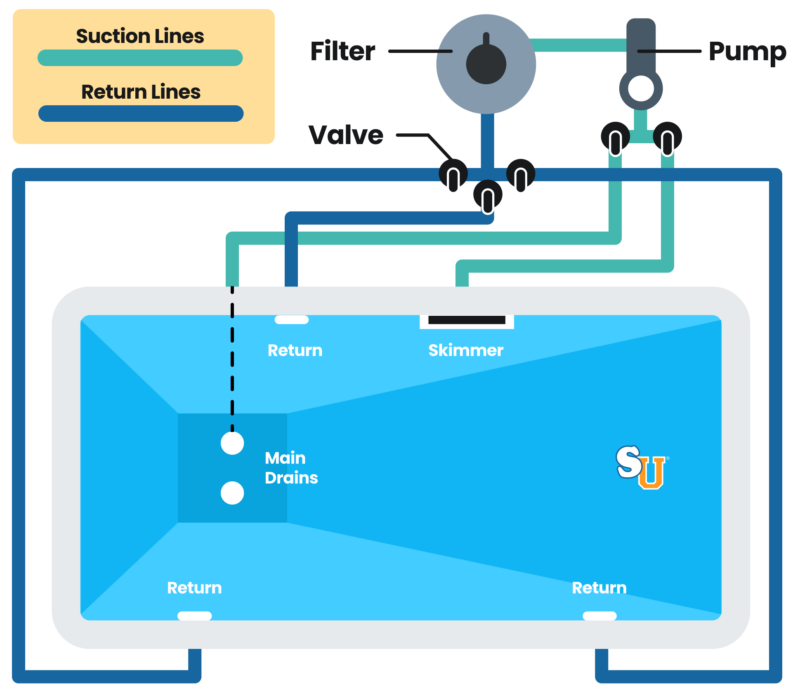
The next step is to learn the role each part plays in your pool’s circulation and health.
No part of a pool circulation system is any more important than another. They all do something different, and all play a critical role in keeping water moving into and out of your pool to help keep it clean, healthy, and swimmable.
The Suction Side of Your Pool Plumbing
Your pump is the heart of your pool. Everything in front of the pump is considered the suction side. Everything after the pump is considered the pressure side. We’re going to start with breaking down the parts of the suction side of your pool.
Skimmer
This is a space on the inner wall of your pool where water enters the pool plumbing system. Your pool may have more than one skimmer, depending on its size.
Inside the skimmer is a basket that collects larger debris like leaves, twigs, and bugs from entering the plumbing lines.
A skimmer will sometimes have a door—called a weir or floating weir—that is pushed inward when water passes through it. Otherwise, it stays shut to help keep debris from collecting in the skimmer basket and getting into the plumbing.
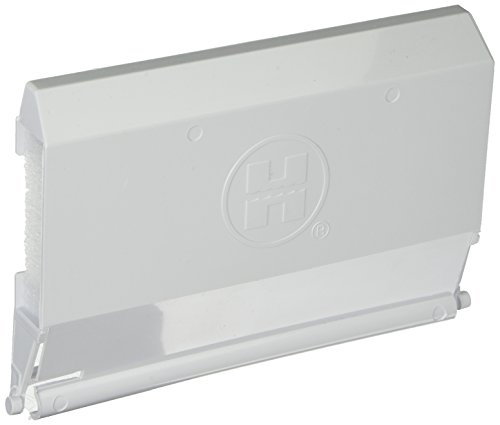
This replacement weir fits inside your skimmer to help control water flow and keep debris from floating back into your pool.
Main Drain
Every inground pool has a main drain at the bottom of the deep end. Depending on the size of your pool, there may be more than one main drain.
Important: It’s never a good idea to completely drain your pool. Removing the water pressure from the pool walls can cause all kinds of damage, from cracking to the entire pool literally popping out of the ground.
If your pool needs to be drained for cleaning, repair, or painting, we highly recommend consulting a professional to avoid damaging or ruining your pool.
Suction Cleaner Port
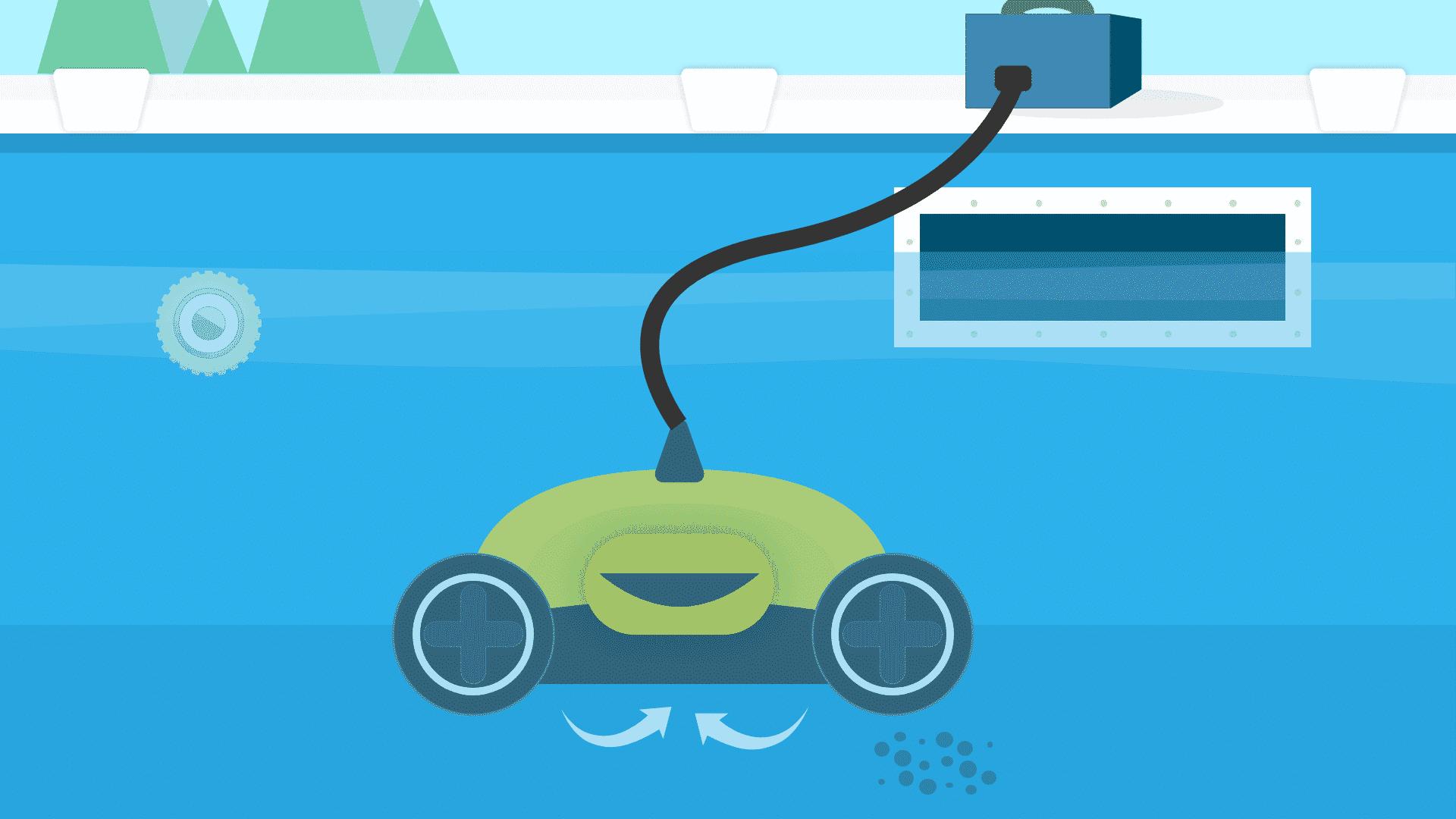
Some pools may have a dedicated automatic cleaner port, which allows you to hook up a suction-side pool cleaner. This is a dedicated line that runs directly to your pump and allows you to power a suction-side pool cleaner when the valve is open and when a cleaner is installed.
Suction Lines
Once the water has passed through the skimmer basket, it enters a suction line. This is basically a plumbing pipe, usually made from PVC. The entry point is connected to the skimmer, and the endpoint is connected to the pump.
Pump
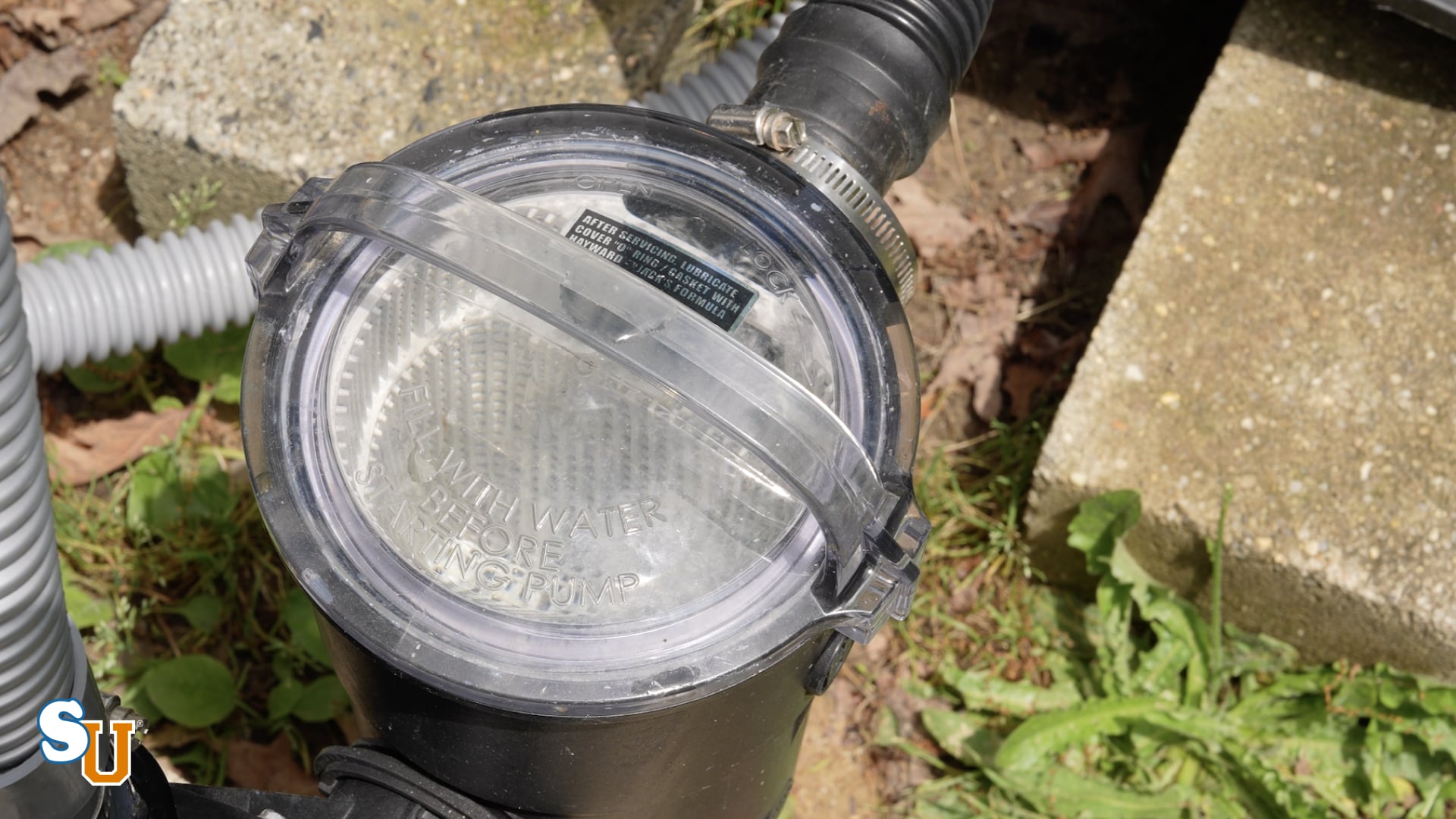
Pool water doesn’t just move through the suction lines on its own. When the pool pump is on, it creates suction power, which moves water through the suction line, drawing it from the skimmer into the pump.
Remember, the pump is the heart of your pool. It draws water in and then expels it into the filter through a continuation of the suction line.
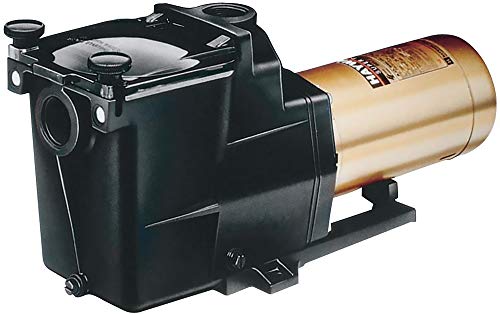
The Hayward Super Pump Single-Speed 1 HP Pool Pump sets the industry standard for efficiency and dependability and is part of the world’s best-selling medium-head pump family.
Important: One of the worst things for a pool pump is for it to run dry. It’s made to have water in it, and when the water is either too low or not present at all, the pump can be damaged. The best way to avoid this is to ensure your pool’s water level is high enough to continually enter the skimmer, while also not completely covering the skimmer.
The Pressure Side Of Your Pool Plumbing
Once the water is pulled into your pump, the pump pushes it out through your filter, and then possibly into a chlorinator, a salt system, a heater, and then back into your pool. This is all known as the pressure side of your pool.
Filter
Pool water leaves the pump and enters the filter to be cleaned. Depending on the type of pool filter you have, it may remove everything from larger debris like leaf litter and bugs to hair and bacteria.
Return Lines
Now that the water is clean, it can go back into the pool through the return lines. Again, these are simply pipes made of PVC that extend from the filter to the pool returns.
Returns
You may have also heard these called jets or return jets. They’re small openings around the pool wall through which the now-cleaned water reenters the pool. You’ll want the wall returns facing in such a way that they continually circulate the pool water.
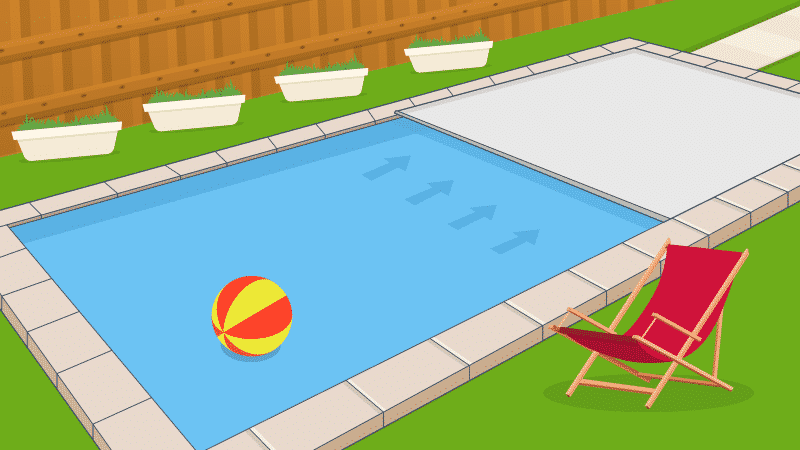
For example, imagine standing on one side of your pool, the shallow end to your left, the deep end to your right. Let’s say the returns are on the wall opposite you, and the skimmer is on the side where you’re standing.
You’d point all the wall jets to the right, toward the deep end. This would move the water in one direction and force it around to the skimmer, creating literal pool circulation.
The return jets in the shallow end should each face a different direction to keep water from stagnating over the steps.

This return jet fitting lets you aim water flow in any direction to help improve circulation and keep your pool water moving the right way.
Fountains, Slides, Bubblers, and More
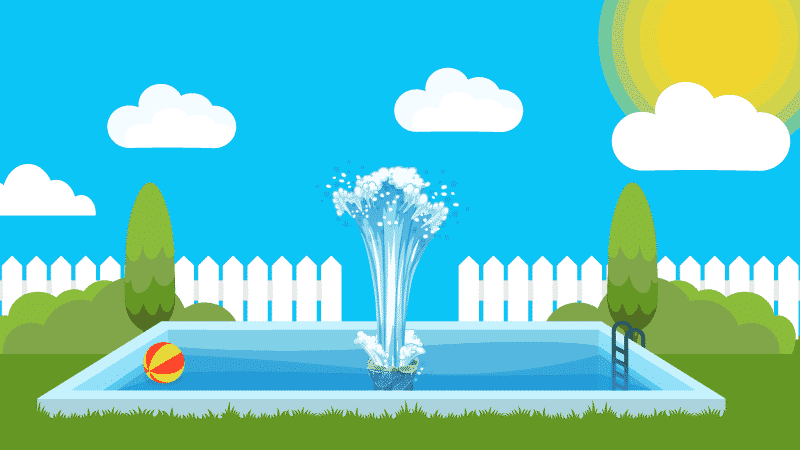
Return jets aren’t the only way water can enter your pool. Depending on how your pool is designed, you could have water fountains, either one main fountain or multiple fountains throughout your pool.
You can have what’s called a bubbler, which is on the floor of your pool and pushes water up and creates turbulence on the water’s surface.
You could have a water slide (if you’re one of the lucky few out there), which also brings clean water back into your pool.
Some pools even have a dedicated automatic pool cleaner line, which is built for a pressure side pool cleaner.
Pool Water
Bet you didn’t think about this, did you? But it’s true. Water is an essential part of every pool plumbing system. Without it, the pump won’t work properly, the filter will dry out, and you’ll break something when you try to dive into the deep end.
Seriously, keeping the right amount of water in your pool is essential for the plumbing system to function properly.
When the weather’s hot, watch for the water level to decrease due to evaporation. When it’s rainy, watch for the level to increase to the point where it covers the skimmers and interferes with the plumbing and circulation.
And always remember that the water isn’t just what you swim in. It’s a big part of what keeps your pool and all its equipment and systems running smoothly.
Properly caring for your pool entails a lot more than just testing the water and adding chemicals. Keeping your pool plumbing system in mind will help you maintain your clean, sparkling pool and extend your equipment’s longevity.
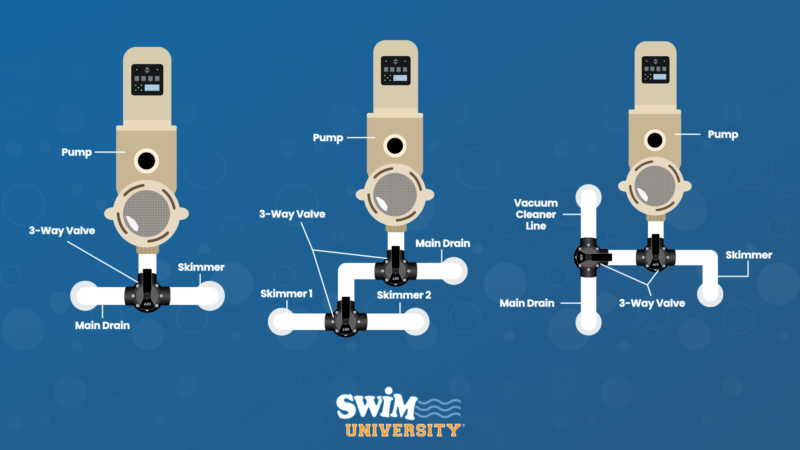
Example Pool Plumbing Diagrams
Here are a few Diagrams of specific filter system plumbing layouts. You may have something related to one of these or something similar. Feel free to save these to your computer if you need help mapping out your pool’s plumbing system.
Key Takeaways
- Your pool’s plumbing system moves water from the skimmer through suction lines to the pump, then through the filter, and back into the pool through return jets.
- The pump is the heart of your pool. It creates the suction that keeps water circulating and the whole system running.
- Point your return jets toward the deep end to create a circular flow that pushes water back toward the skimmer.
- Never let your pump run dry. Keep your water level high enough to continuously feed the skimmer, but not so high that it covers the opening completely.
- Never fully drain an inground pool. Removing the water pressure can crack the walls or cause the pool shell to pop out of the ground.
- Maintaining the right water level isn’t just about swimming. It keeps your equipment protected and your circulation system working properly.